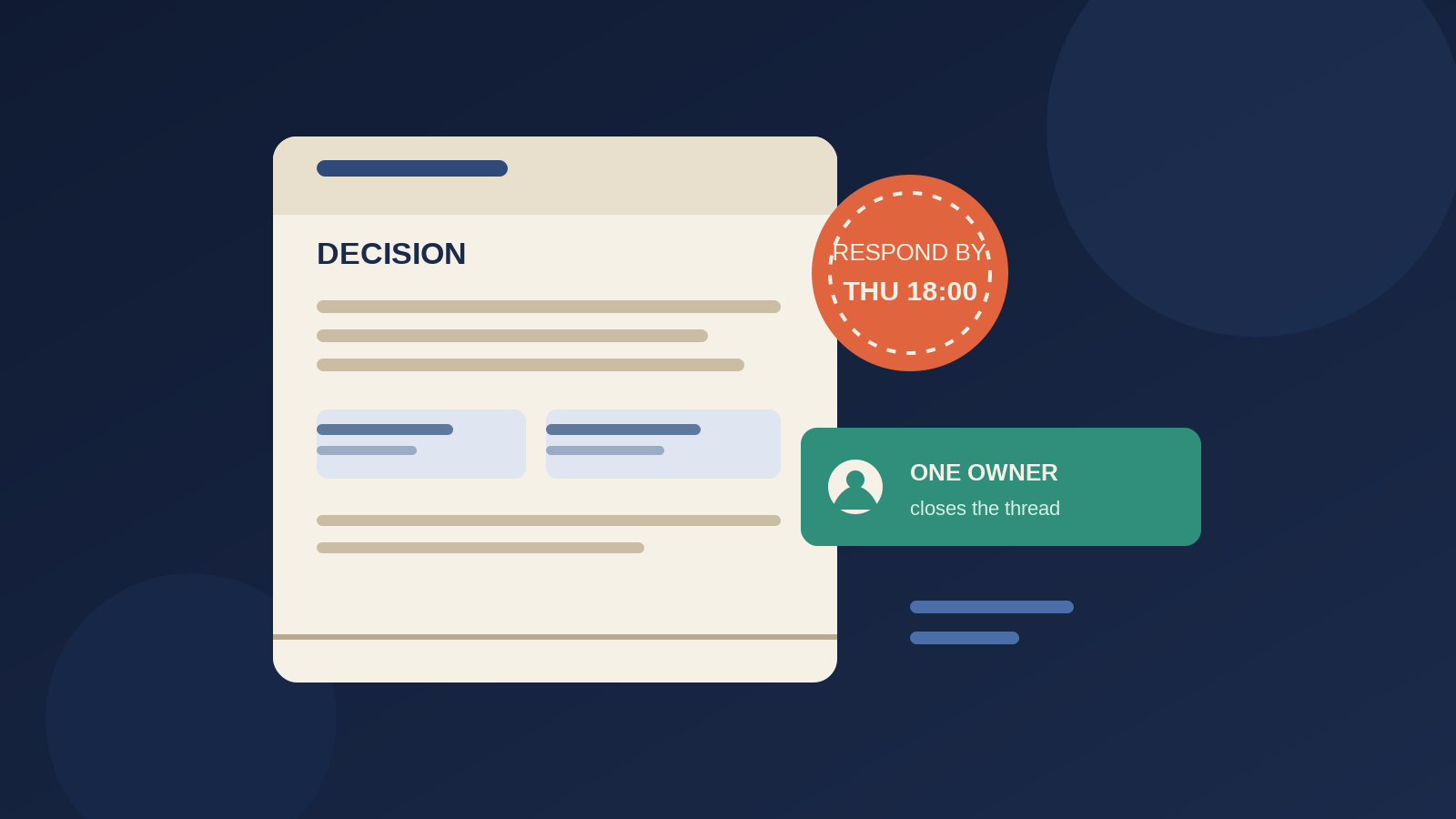
A team agrees in chat to delay a release. Six weeks later, the decision still affects new work, and the people who remember it are on leave. Copy the outcome into a place someone can find by searching for the project or opening the associated task.
Start with the date and the decision in ordinary language. “Release the export on Wednesday after the support team receives the migration guide” is a better record than “Move date” because it includes the condition the team agreed to. Find the person who can confirm the wording before marking it final.
Record why the release moved
For the release decision, the record might contain these fields.
| Field | Example |
|---|---|
| Decision | Release Wednesday after support has the guide. |
| Approved by | The release owner. |
| Why | Support needs a working example before answering questions about changed fields. |
| Alternative considered | Release Monday with the old guide and add new examples later. |
| Reopen if | The guide misses Tuesday’s review or the export changes again. |
| Related work | Release ticket and the current draft guide. |
Atlassian’s DACI framework separates who drives a decision, who approves it, and who contributes information. You can use those roles to find the person who can confirm the outcome and to decide who needs to be informed. For a small decision, record the approver and where the discussion happened. Atlassian
GitLab’s communication handbook describes working in shared artifacts so context can be found later. Put the decision in the tool where the team would expect to look for its consequence. A contributor opening the release ticket should encounter the decision and the guide together. GitLab
Keep the record close to the work it affects
Decide first whether the discussion led to a commitment or still needs someone to approve it. A note like “the team is leaning toward Wednesday” belongs with the options until the release owner confirms the date. Copy the conversation link where appropriate, and put the decision itself next to the release task or operating guide. A teammate can then read the decision before beginning related work. Use a short title with the project name and the actual question, so people can find it when they do not remember which chat thread held the conversation.
Imagine a second team uses the release to schedule customer training. Record what training should move and what stays on the original schedule. “The revised export can be covered on Wednesday after the example guide is approved. Keep Tuesday’s internal review and move external training if the review fails.” This records what changes and what the other team should still do. Link the supporting schedule and name the release owner who can resolve the remaining question. If the term “approved” has a specific meaning in your team’s tool, mention where the approval appears. An observer should be able to verify it without asking the original chat participants.
GitLab’s handbook describes using shared written artifacts to keep project context available to others. Adapt that approach to the place where your contributors already look. If a decision updates the operating guide, edit the guide and link the decision. If it applies only to one launch, record it near that launch and use the normal channel to notify affected people. A public decision log may need a shorter description than a private HR or customer record. Match the content and permissions to the people who need the outcome. GitLab
Check who chose the outcome and under what condition
Suppose the choice depends on two things. Engineering can make the change Wednesday, and support can approve the migration examples Tuesday. Give each condition a name and link the record showing it. The final decision can state that release is planned after both conditions have cleared. It can also say who can change the date. A decision maker might confirm that approval was late and decide to move the date. The observer should have a place to report an issue without mistaking a comment for a new decision.
Atlassian’s DACI example identifies a person who drives the process, one approver, contributors, and people who need to know the result. Use the role named in your actual agreement. You can copy the one approver into the record and ask the person organizing the work to include the outcome in the task. For a simple change, a full responsibility table can be unnecessary. A complicated change may need the supporting owners and a list of affected teams. Atlassian
Compare a decision about one delivery with a choice about all future deliveries. The first might specify a date and review condition for one customer. The other should include which projects use the new rule, when it takes effect, and who updates existing instructions. If an exception lives in the chat record only, a new hire may assume it applies everywhere. Record the scope beside the choice, then add a link in a shared policy or template when the team actually changed its general process.
Test the wording with someone who missed the discussion
Ask a colleague in another shift to open the project and tell you what to do next from the record. They may find two related outcomes, one still open and one final. Check whether the date and decision owner show which applies. Show the draft to a person who uses its consequence without having attended the original meeting. If they read “finish the guide” as a different event than the approver means, use the exact artifact or approval step to fix the wording.
Keep this review short enough to use on ordinary decisions. The writer can check that the record has a date, a clear choice, a reason, and any event that would reopen it. The person who approved it can confirm the statement. A calendar or task update should point back to the same record. Put any changed decision in the same place so later readers can see which choice is current.
Preserve the history when the choice changes
Suppose Tuesday’s review finds a serious incompatibility. Add the new decision with its date and link back to the original. You can mark the old entry superseded and leave its reason available. That keeps other people from trying to reconcile two apparently current statements.
Ask someone who missed the discussion to find the record. They should be able to tell what to do, who confirmed it, and which observation would reopen it. When a condition becomes irrelevant, update the record linked from the active work so people find the current answer first.
If the team still has to settle the question together, choose a suitable decision meeting and bring the open issue into its agenda.